What happens if AI stocks crash? Trusts to cushion your portfolio
A Kepler analyst considers tech volatility, a view of the AI ‘bubble’ as relating to issues in specific sub-sectors, how Anthropic’s like a small-cap, and diversification ideas.
20th November 2026 14:15

This content is provided by Kepler Trust Intelligence, an investment trust focused website for private and professional investors. Kepler Trust Intelligence is a third-party supplier and not part of interactive investor. It is provided for information only and does not constitute a personal recommendation.
Material produced by Kepler Trust Intelligence should be considered a marketing communication, and is not independent research.
Is the AI bubble bursting? The past month has seen lots of unwelcome volatility in AI-related shares, but for all the newsprint spilt, the Nasdaq is only down around 10%, so far at least. This is unwelcome, but hardly a catastrophe, and if a bubble is bursting, there’s still time to get out relatively unscathed.
This is a critical question for all investors, not just those heavily invested in tech funds, as indices are increasingly dominated by technology stocks and earnings and GDP growth increasingly dependent on their success. But the bubble question is vague, suitable for headlines and comment sections, but not helpful for investors. Here we try to unpack what is going on with this critical growth driver of markets and economies.
PERFORMANCE OF US INDICES
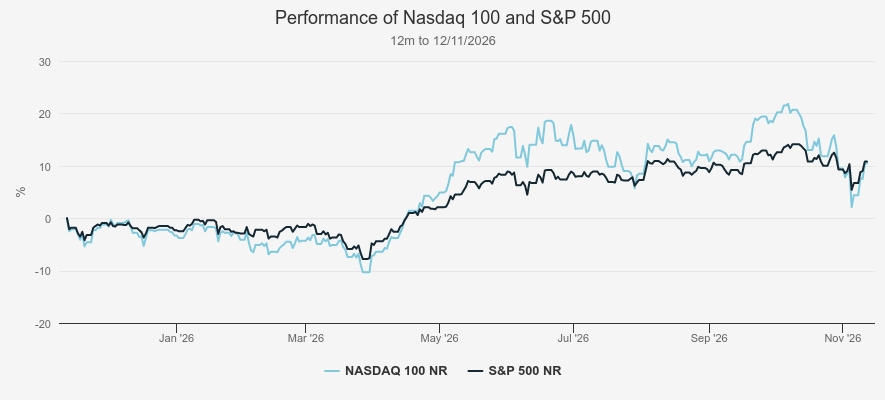
Source: Morningstar. Past performance is not a reliable indicator of future results
Is AI a bubble?
There are a few ways this question can be understood. Even recently, some have been predicting the technology would end up being rejected, or prove itself unreliable for any significant tasks, and suitable only for creating “slop” – unconvincing mimicking of human creative work. That may have been an acceptably punk pose to take in 2022 when the first models were released and used to create short videos of Donald Trump and the Pope’s faces on toddlers’ bodies, but now looks very silly and anyone clinging on to this needs to get real.
The technology has already solved a number of problems in advanced mathematics. In biology, it has enabled scientists to predict protein structures, leading to advances in the understanding of cholesterol and the potential for drug discovery. It has made advances in materials science and helped design a new drug for idiopathic pulmonary fibrosis which has made it through phase II trials (which demonstrate safety), with phase III trials ongoing.
Use in business is accelerating rapidly. The UK Department for Science, Innovation and Technology’s 2026 survey on AI adoption showed that in 2026, 32% of UK businesses were using at least one AI technology, this having doubled from 16% in 2025. Among larger firms it was much higher, unsurprisingly given their larger budgets, at 52%. Knowledge-intensive industries saw the highest adoption: information and communication (61%), real estate (45%) and business services and administration (39%). UK bears might like to note that Britain’s economy is very heavily tilted to services, so productivity increases in these sectors should have a high impact on the economy.
What about valuations then? If the technology is here to stay, are technology companies and the market as a whole expensive? The S&P 500’s forward P/E of 18.1x (as of 10/11) compares to a 10-year average of c. 19x, close to levels seen in the 2016-18 period, pre-Covid and pre-ChatGPT, and well below the c. 25x it hit during the dotcom peak.
According to Yardeni Research, the PEG ratio, which takes the forward P/E and divides it by forecast 5-year earnings growth, is the lowest it has been since 1995, including the aftermath of the 2008 crisis. This shows 1) whether earnings growth meets expectations is the critical question for the US market, even more so than usual, and 2) valuations are not excessive or irrational at the market level. The hyperscalers such as Alphabet Inc Class A (NASDAQ:GOOGL) and Meta Platforms Inc Class A (NASDAQ:META) are spending heavily on AI infrastructure, but prices have started to adjust to reflect this. Meta’s forward P/E of 18.6x is modest compared to its recent history, similarly Alphabet’s 19.3x. NVIDIA Corp (NASDAQ:NVDA), on the other hand, looks extremely cheap at 11.3x forward earnings.
This is likely due to Nvidia being bound up in the data-centre nexus which has come into sharp relief in recent months, as well as concerns about the CEO’s affair with a possible Chinese spy. A more serious interpretation of the AI bubble is that it refers to issues in specific sub-sectors: data centres, hardware and LLMs, which could potentially spill over to bring down the tech sector as a whole and therefore global markets. This is a more worrying interpretation which deserves some analysis.
Is there a bubble in the LLMs?
Early in the summer, shares in CoreWeave Inc Ordinary Shares - Class A (NASDAQ:CRWV), the data-centre provider, started to sell off on concerns about profitability. In early October, a general sell-off in related names hit hard, many companies down 10%+ in a day on 14/10 and/or 16/10. Rising US interest rates highlight the cost of servicing the debt used to construct the data centres. At the same time, there were concerns that demand might not be as strong as anticipated. It’s hard to find any evidence for this, though. It is true that many projects have been delayed, and the scope of the build-out might be slower than indicated.
For example, Exelon Corp (NASDAQ:EXC) cut its high-probability data-centre demand estimate by 40% to 11 GW in July. A number of bearish articles in the press, including Reuters, collated such data points. However, the data points to a slowdown in construction, not in demand. So it may be that investors in Coreweave et al might need to reassess the economics of their businesses, but this isn’t necessarily negative for related AI businesses. Importantly, GPU rental prices remain strong, a critical piece of evidence current data centre supply can’t meet demand.
Mike Seidenberg, manager of Allianz Technology Trust Ord (LSE:ATT) (ATT) notes that while some semiconductor names are expensive, when speaking to companies he finds the story almost universally bullish, with bulging order books and strong pricing power. Ultimately, Coreweave announced that customer demand was 10x its current supply capacity on its most recent earnings call. Meanwhile, CBRE data shows 1.4% vacancy rates in US data centres, 8.3% rental growth and 80% of assets in construction pre-leased.
Bears point to the possibility that new LLMs will be more efficient and require less compute, and therefore less data-centre capacity. In the UK, Revolut declaring it had switched from Claude to a cheaper, bespoke model, has been held up as a potential warning sign. The hyperscalers announcing results with massive spend on compute costs eating up free cash flow may also have raised some suspicions they will be forced to slow down by shareholders. We think the latter is highly unlikely: given the potential for AI across enterprise and consumer uses, Meta, Amazon.com Inc (NASDAQ:AMZN), Microsoft Corp (NASDAQ:MSFT) and Alphabet simply have to be winners from AI.
By far the most plausible route to any of them losing their hegemonic status in their industries is AI enabling a competitor to leapfrog them. In our view, Microsoft could be vulnerable to Anthropic, PBC Ordinary Shares - Class A (NASDAQ:ANT), for example (as we write, the latter has announced the launch of Claude Sheets), and Alphabet to ChatGPT or whoever wins the consumer war. ChatGPT already handles 20% of Google’s search query volume, but so far earns less than 2% of its ad revenue. Low or negative cashflow might require a slightly lower earnings multiple, but that doesn’t equate to a crash.
But what about the threat of cheaper, more efficient systems? This is one of the bear points made against the IPO of Anthropic. In our view, Anthropic is well-placed to be the leader in enterprise AI. This would mean being incorporated into the systems of highly regulated industries like financial services, and into international businesses of systemic importance and open to cyberattack and industrial espionage. Regulation is only going to get tighter in the space, which will make switching to new models harder and costlier, particularly as they become entwined in a business. And we think that the idea the West will allow Chinese AI models to cannibalise its markets is naïve in a world of resource nationalism. It’s not only the US, but the EU is also considering new tariffs to protect itself from Chinese goods, showing that for all the anti-Trump sentiment, Europe views China as the threat and the US as its ally. The US was vocal in its objection to Chinese 5G tech being used in the UK and willing to twist its ally’s arm to turf it out, and we think the approach to AI will be the same.
From a more economic angle, consider how entrenched Bloomberg’s position is for financial data, despite a number of competitors attacking it. Anthropic’s current pricing structure is much more generous for smaller businesses, the thinking being that when a business grows, it will be dependent on Anthropic’s systems and the pricing can ratchet up. If the company’s market position is as strong as we think, then it will be in a position to reap the benefits of the cheaper, more efficient models, and its profitability will be higher.
Moreover, as Tom Slater, manager of Scottish Mortgage Ord (LSE:SMT) is prone to remind us, this is the worst version of AI we are going to get. There may be some low-value processes which can be handed to cheaper models, like chatbots which we think will completely replace human call centres in time, but when it comes to the higher value, core parts of a business, capabilities are going to grow and grow. And developing better models requires scale.
Anthropic is in a period of exceptionally high growth which makes valuation hard. On trailing revenues, the mooted IPO valuation of $1.4 trillion implies a multiple of c. 19x sales (annualising its Q3 figures). However, if the company’s growth projections for 2028 are fulfilled, the multiple falls to around 7x. For comparison’s sake, the one-year forward revenue multiples for Microsoft and Alphabet are around 9x and 7x. Investors are being asked to pay a price which assumes exceptional growth for another two years, with continued growth from that point necessary to justify a multiple like that of the global hegemons.
Bears point to the lease obligations for data centres that it has, but headline numbers of $900 billion are cumulative, not annual, and include around $214 billion with contingencies attached (i.e. are not fully committed to). Annualising the Q3 revenue gets to $68 billion, which compares to cash commitments over the next 12 months of $71 billion, although c. $24 billion is cancellable. Average commitments to 2030 are around $115 billion. Anthropic has about $96 billion in cash.
Getting a bit more blue sky, we note that Microsoft’s market cap is around $3.9 trillion. If Anthropic can gain the dominant position in enterprise AI use, a similar market cap might make sense. There’s no question it is a high-risk growth stock, and perhaps the recent sell-off in AI names shows there are likely to be more such sell-offs on narrative before the companies can ‘prove it’, but the valuation doesn’t seem mad to us, and doesn’t look bubblicious. Perhaps we should be thinking about Anthropic like it’s a small cap?
What would an AI crash mean?
For these reasons, we don’t think there is a bubble, and we don’t think this is dotcom 2.0. Anthropic is set to IPO before OpenAI because it has achieved profitability, but OpenAI is on course to lose around $14 billion in 2026, on revenues around the same as those of Anthropic. What if either OpenAI or Anthropic fail? One of the main sources of risk in the companies is the usage-based revenues, i.e. that fixed contractual payments only make up around 20% of Anthropic’s revenues. What if competitors do emerge which take a lot of the usage away, and the companies aren’t able to meet their obligations?
We think a critical point is that if cheaper competition emerged, it would also need compute and also need data-centre capacity. Companies like Coreweave might run into trouble, but its assets would remain in high demand and might be picked up on the cheap – perhaps by the hyperscalers? Given the potential of the technology, we think it unlikely that any reduction in token demand due to efficiencies would offset any growth in demand due to increased use of AI – we are still very early in its diffusion through the economy.
However, if growth in revenues from AI services doesn’t hit expectations, there would be serious knock-on effects. Pimco estimates AI investment added about 0.4pp to annualised US real GDP growth since early 2025, out of roughly 2% growth. However, it contributed about 1.2pp to the 2.7% average growth in US domestic demand over the same period, and higher equity valuations on productivity hopes add an estimated 0.5–0.7pp. So, if companies consolidate their spending and investors retreat, there could be a slowdown in the US economy. The UK too would be vulnerable: last week’s strong GDP growth number was attributed to AI spend in the software sector.
We think a couple of areas might prove more resilient in the AI nexus if markets pull back. One is cybersecurity. The rapid development of AI and the creation of autonomous systems raises the prospect of bad actors using it to hack and bring down services, as well as the more random risk of the systems themselves breaking things (as seen in the Hugging Face hack). Massive investment in cybersecurity is going to be necessary, whoever the winners are in the LLM or software space. This is an area of high conviction for Mike Seidenberg of ATT.
Materials and power make up another area where we think the AI impulse should remain strong whoever wins: data-centre construction and grid build-out is lagging demand, and will have to accelerate to facilitate the newer and better models that will be on the way. Nuclear power related names have been hit very hard by the weakness in AI names over the past few months. A considerable amount of the extra capacity expected to come online in the future is to meet AI demand, and the IEA identifies 45GW of announced SMR capacity currently planned is to meet that. This is equivalent to around 60% of the supply deficit in 2035 and 20% in 2040. If we take this as illustrative of pure AI demand, a massive simplification, then there would still be a need for investment in new nuclear capacity if all AI capex plans were halted. Uranium and nuclear power stocks could therefore be a high-risk contrarian recovery play, even if AI growth slows. Geiger Counter Ord (LSE:GCL) offers a way to play this, and trades on a 5% discount at the time of writing. Kepler will be publishing an update after a meeting with the new manager in the coming weeks.
Where can you get diversification?
We do think a major issue for investors at the moment is where to find diversification. Even if they’re bullish on AI, a sensible investor will want to have some investments that aren’t dependent on its success. However, AI is increasingly dominating market indices and driving economic growth, and finding off-setting exposures is difficult. The heavy weighting to tech in Asian indices and emerging market indices is evident.
Meanwhile, key commodities like copper have become quite correlated to the data centra and power grid build-out trade. So much so, that AI has helped create a wealth effect in countries like Chile, as commodity revenues and taxes flow through the economy. So, commodities and emerging markets as well as all the key developed markets are highly dependent on the success of the AI trade. Where, then, can investors get some protection?
Any AI slowdown would have to be bullish for bonds. Given the importance of AI spend, GDP growth, pricing pressures and rates should all be expected to fall, which argues for exposure to high quality bonds. Pimco favours investment-grade corporate credit for protection. Investors might also look to rate-sensitive sectors like infrastructure or commercial property. Schroder Real Estate Invest Ord (LSE:SREI)has moved out to a 33% discount at the time of writing. Given this wide discount and the gearing, we might see some strong share price returns if a slowing economy leads to rate cuts being mooted.
In the infrastructure space, we continue to think Greencoat UK Wind (LSE:UKW) looks decent value on an 8.8% discount after share price returns of 36% this year. At the margin, a data centre slowdown reduces the expected ramp up of power demand, but there are plenty of structural factors supporting renewables and power prices, in our view. The managers of Ruffer Investment Company (LSE:RICA) have spent lots of time thinking about the consequences of an AI slowdown. They think there is one possible scenario in which growth continues and the benefit of AI diffuses through the economy, and hold equities in a number of cheaper sectors and industries they think will benefit. However, the possibility of a growth shock caused by an AI slowdown features highly in their portfolio positioning, and they hold a number of assets, including credit protections, put options and currencies, which they think could give shareholders powerful returns if the leading story in markets sells off.
In the growth space, there are few stories that are not dependent on AI, but one exception is biotechnology. As we discussed in a recent note on International Biotechnology Ord (LSE:IBT), the bullish outlook for the industry is supported by internal dynamics, namely the need of large-cap pharma to replace drugs with expiring patents, along with advances being made in multiple modalities. Biotech Growth Ord (LSE:BIOG)is another trust to be benefiting, and we updated on it recently.
The Vietnamese trusts may offer another uncorrelated growth story. Vietnam has had a poor year of returns, but GDP growth has been strong and there is strong policy support for infrastructure spend and reform which bodes well for the future. Trusts like Vietnam Enterprise Ord (LSE:VEIL)offer diversified exposure to what could be an exciting growth story.
Conclusion: is there an AI bubble?
One of the ways in which history rhymes is people continually view the present in terms of the past, but AI is a genuinely new phenomenon, and obsessing over the possibility of a repeat of the dotcom bubble is a poor way to approach making money in markets. We don’t see any evidence that AI is a bubble. The valuations of OpenAI and Anthropic imply some very high growth rates, but there is a reasonable path to achieving them. We think they are a lot like small-caps, opening up a new market with huge potential, except that in the internet era, the addressable market is the whole world, not just market towns around one country, and these small-caps are some of the largest companies in it. Perhaps investors would be wise to apply the same position sizing and risk assumptions to AI-heavy investments as they do to the small-cap funds they hold?
Clearly heroic growth assumptions have been read across to areas like uranium (which hasn’t recovered from its recent drawdown) and data centres (which have recovered, at least at the time of writing). The Korean memory stocks were bid up massively by investors chasing momentum and this has ended in a crash. Some of the assumptions behind the earnings potential of AI may prove generous, and some business models may fail, and given the sensitivity to earnings growth in valuations across the vital sectors, and given how important to GDP growth AI spending has become, we do think volatility will remain elevated, and we do think there is a real risk of a slowdown in spend which could hit global markets meaningfully.
All this is different from saying there is a bubble, and a repeat of 2000-01 is on the cards. However, diversification into rate-sensitive assets and uncorrelated growth stories seems a wise hedge against a slowdown. Particularly so as many markets have become highly dependent on AI spend and related share prices, and so the geographical diversification which might have worked five years ago doesn’t look like it will do the same job.
Kepler Partners is a third-party supplier and not part of interactive investor. Neither Kepler Partners or interactive investor will be responsible for any losses that may be incurred as a result of a trading idea.
These articles are provided for information purposes only. Occasionally, an opinion about whether to buy or sell a specific investment may be provided by third parties. The content is not intended to be a personal recommendation to buy or sell any financial instrument or product, or to adopt any investment strategy as it is not provided based on an assessment of your investing knowledge and experience, your financial situation or your investment objectives. The value of your investments, and the income derived from them, may go down as well as up. You may not get back all the money that you invest. The investments referred to in this article may not be suitable for all investors, and if in doubt, an investor should seek advice from a qualified investment adviser.
Full performance can be found on the company or index summary page on the interactive investor website. Simply click on the company's or index name highlighted in the article.
Important Information
Kepler Partners is not authorised to make recommendations to Retail Clients. This report is based on factual information only, and is solely for information purposes only and any views contained in it must not be construed as investment or tax advice or a recommendation to buy, sell or take any action in relation to any investment.
This report has been issued by Kepler Partners LLP solely for information purposes only and the views contained in it must not be construed as investment or tax advice or a recommendation to buy, sell or take any action in relation to any investment. If you are unclear about any of the information on this website or its suitability for you, please contact your financial or tax adviser, or an independent financial or tax adviser before making any investment or financial decisions.
The information provided on this website is not intended for distribution to, or use by, any person or entity in any jurisdiction or country where such distribution or use would be contrary to law or regulation or which would subject Kepler Partners LLP to any registration requirement within such jurisdiction or country. Persons who access this information are required to inform themselves and to comply with any such restrictions. In particular, this website is exclusively for non-US Persons. The information in this website is not for distribution to and does not constitute an offer to sell or the solicitation of any offer to buy any securities in the United States of America to or for the benefit of US Persons.
This is a marketing document, should be considered non-independent research and is subject to the rules in COBS 12.3 relating to such research. It has not been prepared in accordance with legal requirements designed to promote the independence of investment research.
No representation or warranty, express or implied, is given by any person as to the accuracy or completeness of the information and no responsibility or liability is accepted for the accuracy or sufficiency of any of the information, for any errors, omissions or misstatements, negligent or otherwise. Any views and opinions, whilst given in good faith, are subject to change without notice.
This is not an official confirmation of terms and is not to be taken as advice to take any action in relation to any investment mentioned herein. Any prices or quotations contained herein are indicative only.
Kepler Partners LLP (including its partners, employees and representatives) or a connected person may have positions in or options on the securities detailed in this report, and may buy, sell or offer to purchase or sell such securities from time to time, but will at all times be subject to restrictions imposed by the firm's internal rules. A copy of the firm's conflict of interest policy is available on request.
Past performance is not necessarily a guide to the future. The value of investments can fall as well as rise and you may get back less than you invested when you decide to sell your investments. It is strongly recommended that Independent financial advice should be taken before entering into any financial transaction.
PLEASE SEE ALSO OUR TERMS AND CONDITIONS
Kepler Partners LLP is a limited liability partnership registered in England and Wales at 9/10 Savile Row, London W1S 3PF with registered number OC334771.
Kepler Partners LLP is authorised and regulated by the Financial Conduct Authority.