Biggest FTSE 100 fallers this week
Global stock markets have been hit hard by fresh conflict in the Middle East. City writer Graeme Evans looks at the biggest blue-chip fallers and a handful of risers.
3rd March 2026 14:11
by Graeme Evans from interactive investor
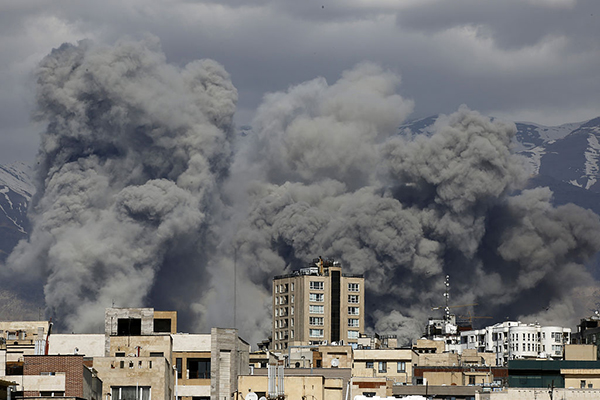
Clouds of smoke fill the air following air strikes in the Iranian capital, Tehran, on 1 March. Photo: Fatemeh Bahrami/Anadolu via Getty Images.
Fears of an energy price shock today swept through global markets to leave the FTSE 100 index as much as 3% lower and HSBC Holdings (LSE:HSBA) shares 10% off last week’s all-time high.
British Airways owner International Consolidated Airlines Group SA (LSE:IAG) has now shed 11.5% since posting “world-class” results on Friday, while Lloyds Banking Group (LSE:LLOY) is down 6% over the same period to well below the 100p mark.
- Learn with ii: What is Bed & ISA? | What is the ISA Deadline? | How many ISAs can I have?
British Land Co (LSE:BLND) and Barratt Redrow (LSE:BTRW) are off by a similar level as investors have begun to revise their previous expectations for further interest rate cuts in the coming months.
Biggest FTSE 100 fallers this week
Company | Price | Today's change (%) | Change this week (%) | Change past month (%) | Change past year (%) | Forward dividend yield (%) | Forward PE |
4097p | -13.6 | -13.2 | -6.6 | -20.5 | 3.4 | 18.9 | |
374.85p | -6.4 | -11.5 | -13.4 | 8.6 | 2.3 | 6.7 | |
1263p | -5.2 | -9.4 | -2.9 | 34.0 | 4.0 | 11.9 | |
74.52p | -4.3 | -9.1 | -9.5 | -5.8 | 1.3 | 6.9 | |
3888p | -6.5 | -8.9 | 0.5 | 118.0 | 1.3 | 31.9 | |
1673p | -3.6 | -8.7 | -11.0 | 31.9 | 2.9 | 10.0 | |
1062.25p | -4.2 | -8.7 | -1.0 | -4.1 | 54.8 | ||
3384p | -5.7 | -8.6 | -8.5 | 43.4 | 2.6 | 28.5 | |
415.825p | -4.9 | -8.2 | -17.1 | 33.7 | 3.4 | 8.2 | |
427.45p | -5.0 | -7.9 | -12.9 | -15.1 | 3.1 | 6.5 |
Source: ShareScope.
The dramatic turn in sentiment follows the effective closure of the Strait of Hormuz to commercial traffic and interruption of Qatari liquefied natural gas (LNG) production.
Brent crude today hit its highest level since July 2024 at more than $84 a barrel, representing a rise of more than 16% since the US and Israel launched their attacks on Iran over the weekend.
- Stockwatch: should investors back these four oil stocks?
- Market snapshot: FTSE 100 looking for a floor
The rise in the natural gas price has been even more substantial, as the uncertainty over Qatar supplies heighten fears that Europe faces another bout of supply disruption in line with that seen in the early stages of the Russia/Ukraine war.
Those worries were today reflected in the performance of Frankfurt’s Dax benchmark, which retreated by more than 3.5%, and by a 3% loss for the Cac 40 in Paris. And the Vix volatility index, the so-called fear gauge, briefly surpassed 27 for the first time since November. For context, a read above 30 typically indicates more extreme market fear and uncertainty. The index peaked at 60 after last year’s Liberation Day tariffs.
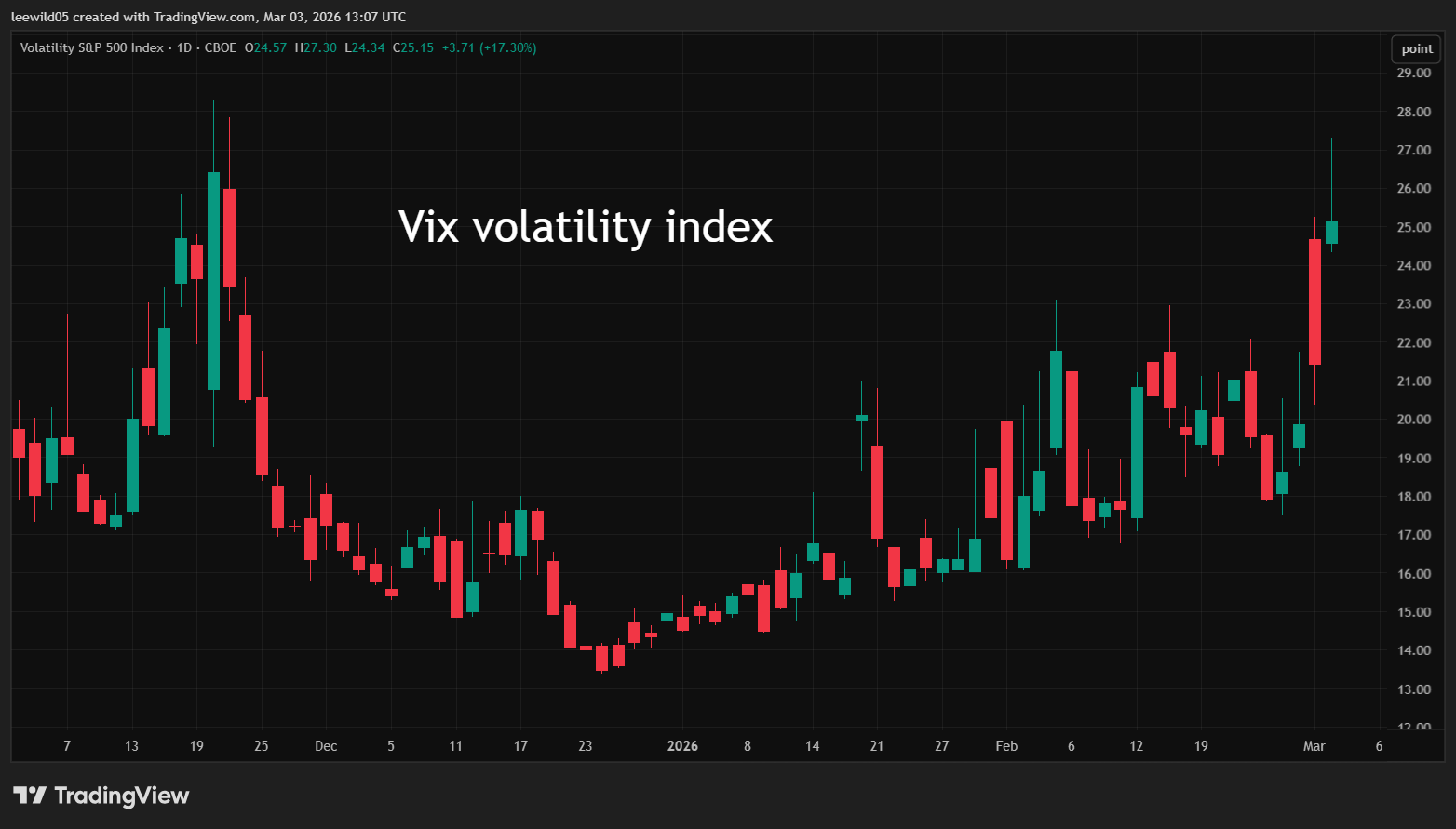
Source: TradingView.
The FTSE 100 index followed Monday’s relative resilience by dropping as much as 334 points to 10,445 as traders braced for a weak start to the session on Wall Street. Despite this week’s losses, London’s top flight remains 5% higher so far this year.
The potential economic impact of the conflict has stalled the recent progress of HSBC and other stocks in the banking sector, while Rolls-Royce Holdings (LSE:RR.) today traded below where it stood before last week’s better-than-expected annual results.
Much higher crude oil prices failed to translate into a boost for Shell (LSE:SHEL) shares, which are slightly lower since Friday due to the conflict’s impact on LNG operations in the Middle East.
Shell is one of the world’s largest LNG suppliers, with around 40 million tonnes of equity capacity. It also has LNG supply projects in operation or under construction in 10 countries including Qatar.
BP (LSE:BP.) has risen 2% since Friday, making the company’s shares the second-best performer in the FTSE 100 behind a 4% rise for BAE Systems (LSE:BA.).
Biggest FTSE 100 risers this week
Company | Price | Today's change (%) | Change this week (%) | Change past month (%) | Change past year (%) | Forward dividend yield (%) | Forward PE |
2195.5p | -2.0 | 4.0 | 13.7 | 36.2 | 1.8 | 27.1 | |
488.025p | 0.0 | 2.2 | 4.6 | 12.8 | 5.2 | 14.9 | |
1290.5p | 0.0 | 1.9 | 11.3 | 44.4 | 2.1 | 11.5 | |
828.5p | -1.4 | 0.8 | -4.9 | -35.5 | 2.8 | 16.9 | |
3094p | -1.2 | 0.7 | 10.9 | 16.5 | 3.6 | 13.4 |
Source: ShareScope.
A period of prolonged disruption in the Middle East is likely to see energy prices surge beyond $100 a barrel and inflation climb further, a scenario that City bank Berenberg thinks US President Donald Trump will want to avoid ahead of November midterm elections.
For now, fears over the conflict’s inflationary impact were reflected in a sharp 3.4% rise in the UK 10-year gilt yield to 4.52%, up from Friday’s one-year low of 4.23%.
Based on last night’s energy prices, Berenberg estimates that UK CPI inflation would likely be 0.7% higher than its 2.1% fourth-quarter forecast due to the impact on petrol prices and household energy bills.
- eyeQ: high-risk stock gives standout signal
- Sign up to our free newsletter for investment ideas, latest news and award-winning analysis
This means the Bank of England is increasingly likely to hold off from delivering another interest rate cut at its next meeting on 19 March.
Berenberg added: “Now the Bank of England may have to wait a little longer for services price inflation to decelerate enough to offset upward pressure from energy prices before cutting again.
“Moreover, as the UK is a net importer of energy, the rise in energy prices will cause the trade deficit to widen and reduce real-economy demand for sterling. The Bank of England will want to avoid inviting any additional downward pressure on to the currency that would stoke inflation.”
These articles are provided for information purposes only. Occasionally, an opinion about whether to buy or sell a specific investment may be provided by third parties. The content is not intended to be a personal recommendation to buy or sell any financial instrument or product, or to adopt any investment strategy as it is not provided based on an assessment of your investing knowledge and experience, your financial situation or your investment objectives. The value of your investments, and the income derived from them, may go down as well as up. You may not get back all the money that you invest. The investments referred to in this article may not be suitable for all investors, and if in doubt, an investor should seek advice from a qualified investment adviser.
Full performance can be found on the company or index summary page on the interactive investor website. Simply click on the company's or index name highlighted in the article.