Wild’s Winter Portfolios 2025: best month so far
After a difficult first half of this six-month strategy, both portfolios have leapt firmly into positive territory. Lee Wild reveals the stocks responsible for the strongest month yet.
11th March 2026 09:10
by Lee Wild from interactive investor

Writing this at the end of a tumultuous week for global financial markets, it seems less relevant to look back on a month that was glorious in comparison. Despite various headwinds, investors chased stocks higher through February, resulting in some spectacular gains. Nevertheless, it’s useful to understand the scale of returns generated by the major indices ahead of the March sell-off.
The FTSE 100 extended its charge as high as 10,934 on the final trading day of the month, propelled higher by takeover activity, precious metals miners, drug stocks and any number of household names. But as Japan’s Nikkei surged 10%, Paris rallied 5% and the German Dax 3%, it was the former Wall Street growth engine that propped up the performance table.
- Learn with ii: How to become an ISA millionaire | ISA Investment Ideas | Top ISA Funds
Given the massive weighting of the big technology names, the Nasdaq Composite fell 3.4% last month. There seems no way to sooth concerns that companies like Meta Platforms Inc Class A (NASDAQ:META), Microsoft Corp (NASDAQ:MSFT), Amazon.com Inc (NASDAQ:AMZN) and Google owner Alphabet Inc Class A (NASDAQ:GOOGL) are spending too much on new technology with no clear idea when there’ll be any payback. Total spend among the sector leaders is tipped to exceed $650 billion (£484 billion) in 2026. The tech-weighted S&P 500 lost 0.9% in February, while the Dow Jones eked out a 0.2% gain.
Over here, blue-chip winners included Schroders (LSE:SDR) on news it had accepted a £9.9 billion takeover approach from US investment manager Nuveen. Endeavour Mining (LSE:EDV) and Fresnillo (LSE:FRES) continued to ride the precious metals wave, up 25% and 14% respectively, while GSK (LSE:GSK) added 17% and AstraZeneca (LSE:AZN) 14%. A quarter of the FTSE rose 10% or more over the month. It was a similar theme in the FTSE 250 where Raspberry Pi Holdings (LSE:RPI) enjoyed a spectacular and peculiar rally that almost doubled its value at one point.
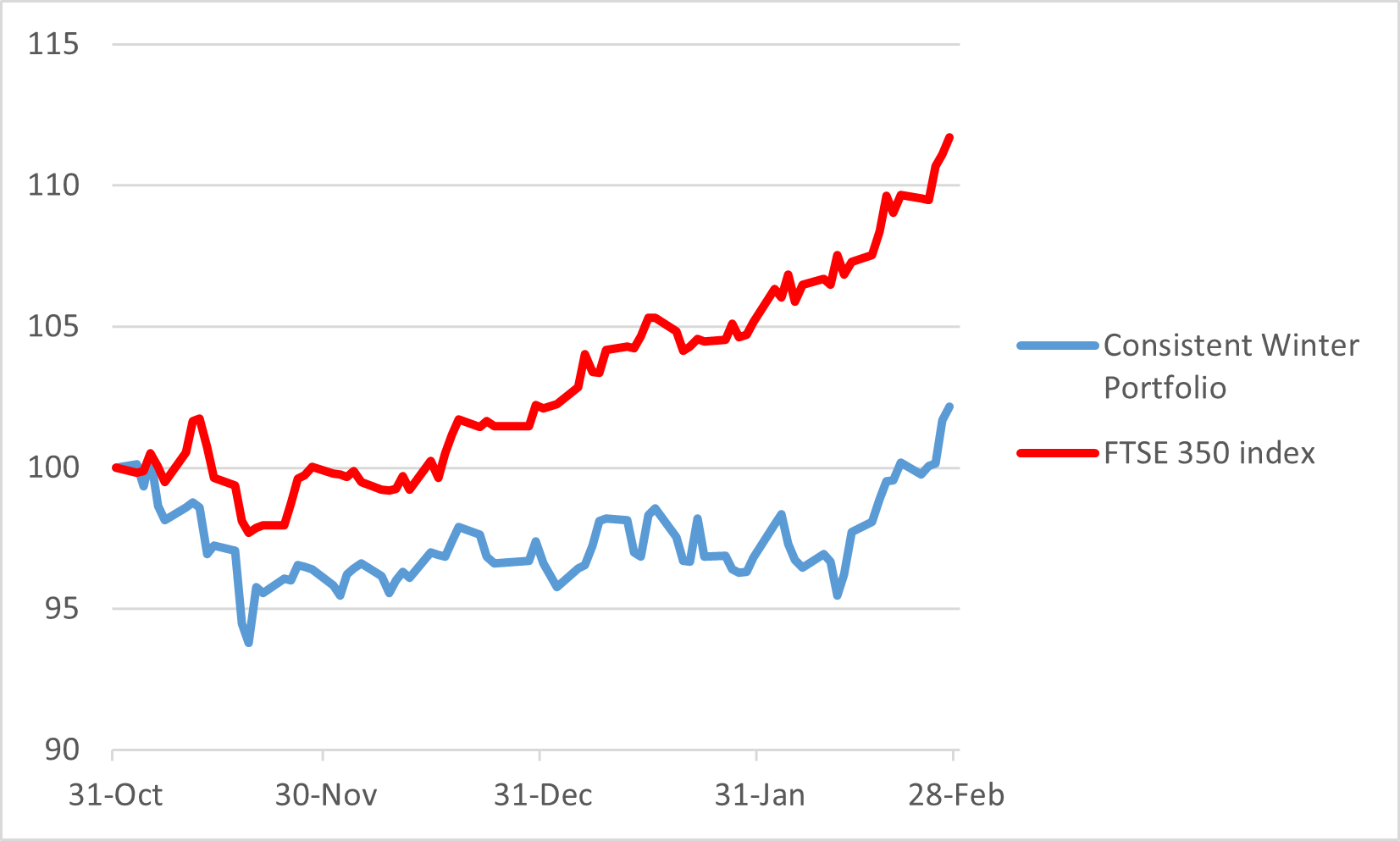
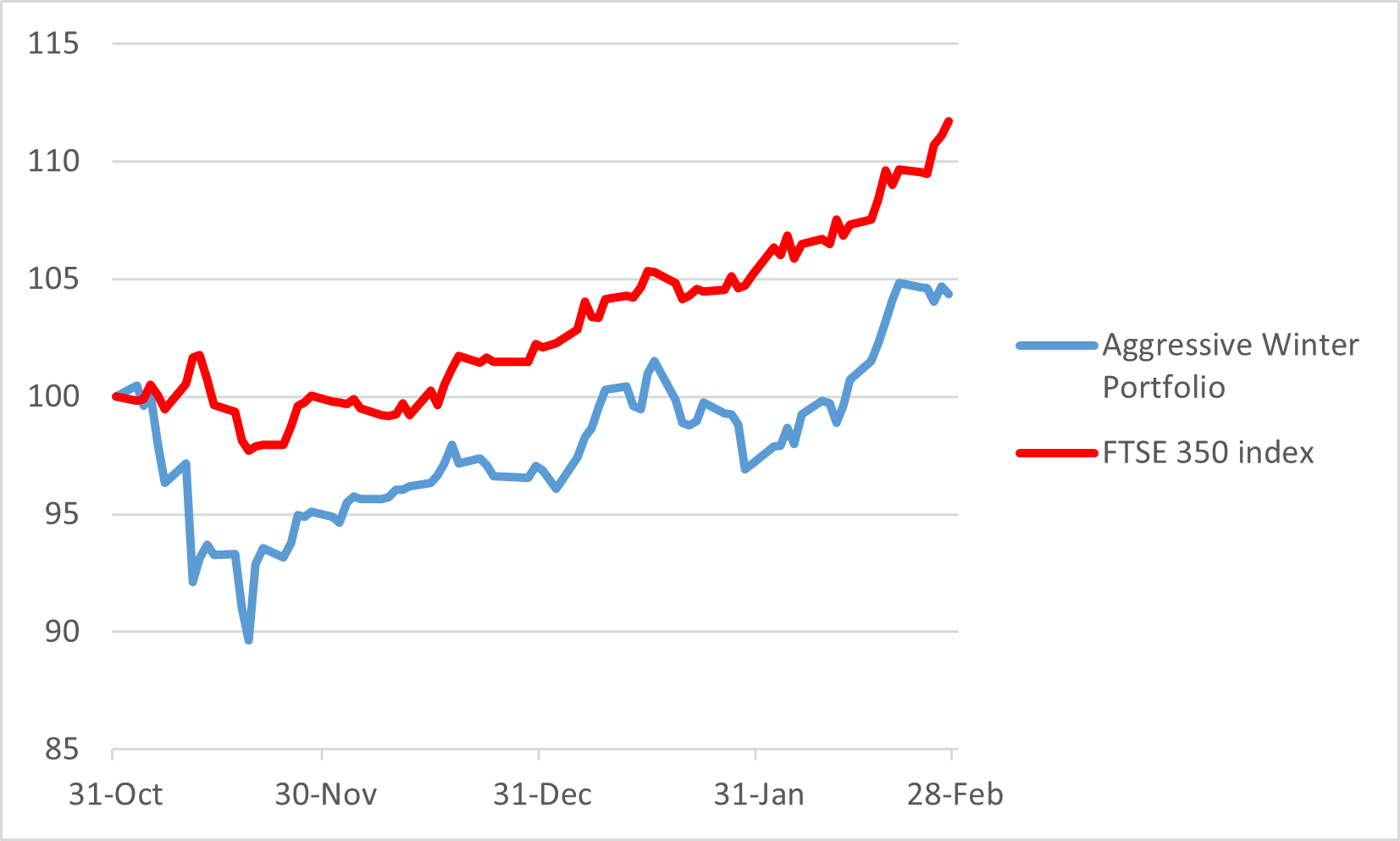
After completing four months of this six-month seasonal strategy, both winter portfolios reflected a buoyant month for UK-listed stocks. Wild’s Consistent Winter Portfolio jumped 5.5% in February, giving a gain so far this winter of 2.1%, the first time it’s been out of the red since early November. Wild’s Aggressive Winter Portfolio did even better, rallying 7.4% for the month and 4.3% this winter. The FTSE 350 had its best month of the season, up 6.2%, taking gains for the past four months to 11.7%.
- Where investment professionals are investing their ISA
- What would a longer war in the Middle East mean for investors?
However, the story in March could not be more different. While oil stocks and the defence sector responded positively to the US/Israeli attack on Iran, most did not, among them the airlines, housebuilders, banks and miners. Major indices have given back a large chunk of their gains, led by Paris and Frankfurt, both down as much as 7% this month. But more on that next time.
As a reminder, the consistent winter portfolio is made up of the five FTSE 350 companies that have risen the most winters (between 1 November and 30 April) over the past decade. Entry criteria is relaxed slightly for the aggressive winter portfolio, giving up some consistency in return for potentially bigger profits. Still, all constituents must have risen in at least eight of the previous 10 winters.
Wild’s Consistent Winter Portfolio 2025-26
Past performance is not a guide to future performance.
There were three big winners in February’s consistent portfolio. Biggest of them all was Halma (LSE:HLMA), with the safety products conglomerate rallying 18% having started the month flat for the winter.
Soft-drinks maker AG Barr (LSE:BAG) issued a full-year trading update at the start of the month, and strong numbers were well received. We’re told performance was in line with expectations and that a 110-basis point increase in adjusted operating margin will mean double-digit profit growth in the financial year ended 31 January. Look out for results on 31 March.
The company, which also spent over £50 million on rivals Fentimans and Frobishers, had a volatile month, but the shares added 9% to end February with a 4% gain so far this winter.
Insurance firm Admiral Group (LSE:ADM) also did well, jumping 7.8% last month to reduce its seasonal deficit to a still uncomfortable 9.5%.
On the downside, IT services firm Computacenter (LSE:CCC) lost 4.6%, narrowing its winter returns to 10.8%, while transport operator FirstGroup (LSE:FGP) slipped another 1.4%, cementing its position at the bottom of the pile with a 12.5% winter deficit.
Wild’s Aggressive Winter Portfolio 2025-26
Past performance is not a guide to future performance.
Engineering contractor Keller Group (LSE:KLR) extended its stellar run this winter with a 13.7% rally in February. It’s now up 26.9% in the first four months of this seasonal portfolio.
The second-best performer last month was Hilton Food Group (LSE:HFG), although it does remain the worst performer of the winter so far. Coming into the month down 27% since the end of October, the shares delivered a monthly gain of 12.5%. A sharp decline following a late January update was quickly recovered early February, investors perhaps encouraged by executive chair Mark Allen who spent almost £200,000 on Hilton Food shares at 468p. Analysts at Deutsche Bank and Berenberg downgraded price targets but still rate the shares a buy. Targets of 815p and 740p respectively are still considerably higher than the current price.
Defence firm BAE Systems (LSE:BA.) added 7% during February, extending its seasonal returns to almost 13%, reaching a record high mid-month. And after dropping almost 10% in January, Games Workshop Group (LSE:GAW) went some way to making amends last month. A 5% improvement leaves the fantasy wargames company up over 12% so far this winter.
These articles are provided for information purposes only. Occasionally, an opinion about whether to buy or sell a specific investment may be provided by third parties. The content is not intended to be a personal recommendation to buy or sell any financial instrument or product, or to adopt any investment strategy as it is not provided based on an assessment of your investing knowledge and experience, your financial situation or your investment objectives. The value of your investments, and the income derived from them, may go down as well as up. You may not get back all the money that you invest. The investments referred to in this article may not be suitable for all investors, and if in doubt, an investor should seek advice from a qualified investment adviser.
Full performance can be found on the company or index summary page on the interactive investor website. Simply click on the company's or index name highlighted in the article.
Disclosure
We use a combination of fundamental and technical analysis in forming our view as to the valuation and prospects of an investment. Where relevant we have set out those particular matters we think are important in the above article, but further detail can be found here.
Please note that our article on this investment should not be considered to be a regular publication.
Details of all recommendations issued by ii during the previous 12-month period can be found here.
ii adheres to a strict code of conduct. Contributors may hold shares or have other interests in companies included in these portfolios, which could create a conflict of interests. Contributors intending to write about any financial instruments in which they have an interest are required to disclose such interest to ii and in the article itself. ii will at all times consider whether such interest impairs the objectivity of the recommendation.
In addition, individuals involved in the production of investment articles are subject to a personal account dealing restriction, which prevents them from placing a transaction in the specified instrument(s) for a period before and for five working days after such publication. This is to avoid personal interests conflicting with the interests of the recipients of those investment articles.