The tariff playbook: why I’m sticking with UK markets in 2026
After reviewing the results of President Trump’s tariff strategy, analyst John Ficenec studies its impact on the UK and how he plans to invest in the year ahead.
17th December 2025 09:00
by John Ficenec from interactive investor
As the year draws to a close and a seasonal torpor descends on the markets, it feels like an age ago when US President Donald Trump sent share prices tumbling and raised fears of a financial crash with his tariffs announcement in April. Now the dust has settled, we can have a look at how effective “Liberation Day” has been for the US economy and also review the performance of some of the shares I thought would do well in the bounce back.
- Our Services: SIPP Account | Stocks & Shares ISA | See all Investment Accounts
Pyrrhic victory
It’s difficult to view Trump’s tariff war as anything but a failure. The central aim was to return the manufacturing and jobs that had been lost overseas to countries such as China. In that respect, there is little evidence of any progress at all, the US jobs market remains moribund.
Figures from the private sector have showed jobs being lost, with ADP private payrolls down 32,000 in November. The wider government figures offer little encouragement, with non-farm payrolls showing 119,900 jobs created in September, but the unemployment rate rising to 4.4% from 4.3% a month earlier. The whole point of the tariff war was to export US unemployment overseas, and in that respect it has so far failed.
Currency wars
There is an argument that the real aim of the tariffs was a classic currency war to boost US trade. As the global economy slows, Trump is seeking to improve US competitiveness by making American products cheaper overseas, in a classic beggar thy neighbour policy.
- Watch our video: ARK Invest’s Cathie Wood on performance, Nvidia and China
- Five macro themes tipped to shape markets in 2026
The US dollar index, the price of the US dollar against a basket of world currencies, is down 10% this year. Cheaper US goods should be a shot in the arm for manufacturing and business, firing up factories and resulting in a rise in employment. Nothing significant has happened yet.
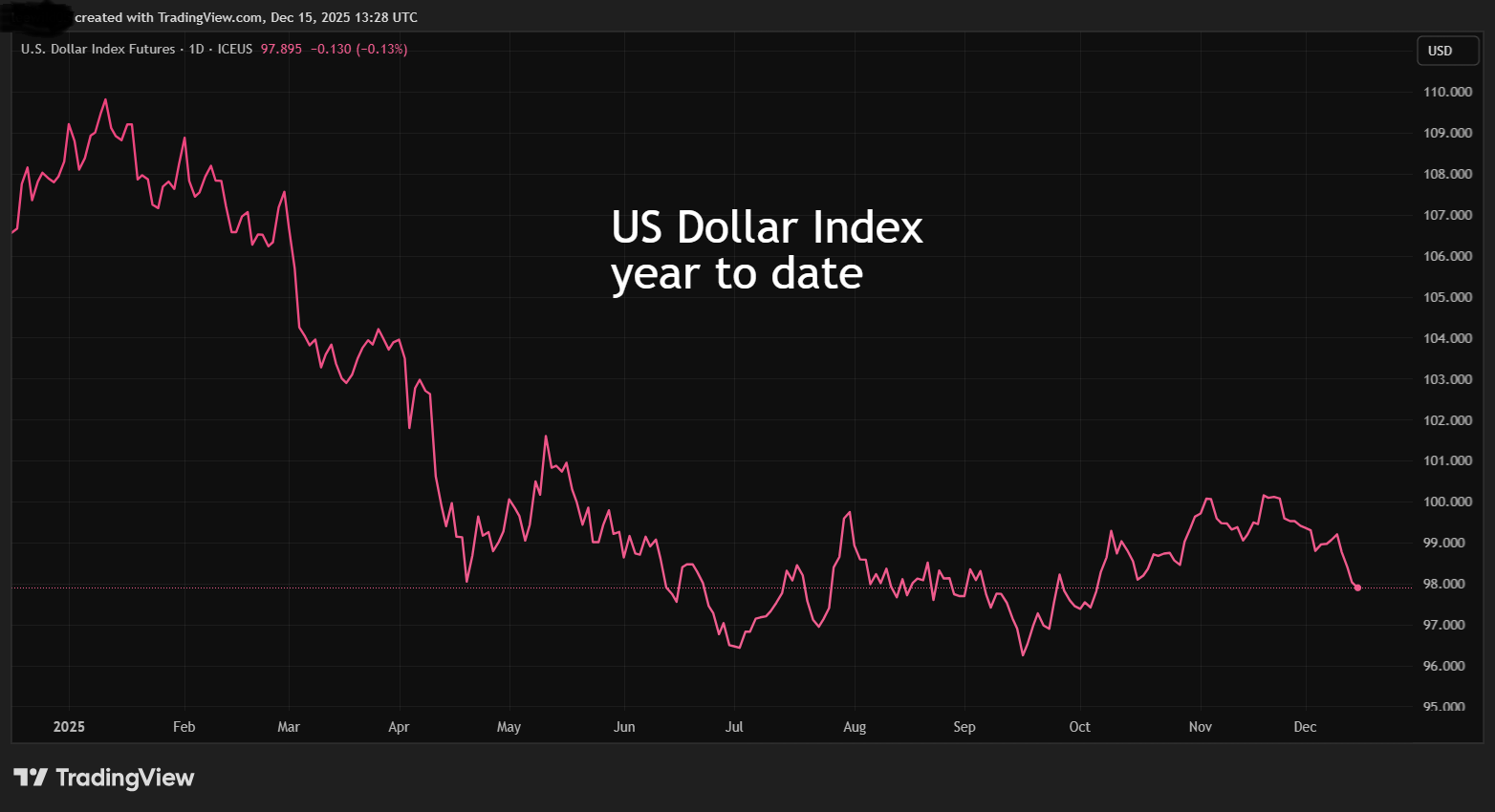
Source: TradingView. Dollar Index is an index of the US dollar relative to a basket of foreign currencies.
If anything, it has backfired and baked in more problems for the US economy, as a weaker dollar has made goods from overseas more expensive and imported inflation. That is loading even more pressure on an already struggling US consumer. The US government shutdown slightly clouded the issue by delaying November inflation data, but in October the US inflation rate increased to 3%, its highest level since January, and well above the 2% Federal Reserve target rate.
There have been very few signs of a shift to buying homegrown US products, that the tariff policy was supposed to encourage. The lower- and middle-income Americans who it was supposed to help with more jobs are now having to pay more for daily life.
Small wins
The tariffs have succeeded in filling the US government coffers in the short term. The amount collected this year is currently around $256 billion (£191 billion), or 150% more than last year. There is also Trump’s big, beautiful bill which aims to cut taxes and increase spending to boost the US economy.
Imports from China are also down sharply, so in that respect it could be considered a limited success. But overall, with global trade now facing higher fees and more paperwork, it’s difficult to get too excited.
Record-breaking markets
Against this sluggish backdrop, one factor that was underestimated was the resilience of US markets. Fuelled by vast spending plans and expectations of earnings from the artificial intelligence (AI) future, the S&P 500 hit a record high 6,920 at the end of October and currently sits just below those levels. One thing to remember from this year is that you write off the US at your peril.
- Outlook for 2026: why more records could be broken
- Watch our video: bargain shares on offer in the UK and beyond
Reviewing the playbook
When the tariffs hit and share prices fell, I was unapologetically enthusiastic about the outlook for UK markets. At the time we looked to be in the eye of the storm as a small trading nation caught between the US and China. However, UK share prices have suffered in recent years and were looking cheap on a number of different measures.
Backing Britain
The call to back the UK proved a solid one. The FTSE 100 is up 17% so far this year, compared to America’s S&P 500 up 16%, not much difference you might argue but it widens when you consider the total return of capital gains plus dividends.
The secret sauce in the UK is that it has more income stocks, so when you add in the 3.2% dividend yield compared to 1.2% in the US, the gap opens up. Finally, there are this year’s currency movements to consider. While I’m always loath to use currency as it’s very much swings and roundabouts, it’s useful to bear in mind to get the whole picture. The pound has strengthened by 6% against the dollar, so the return of the S&P 500 is even weaker in terms of UK pounds.
Building returns
One basket of shares I thought looked interesting was infrastructure. Britain is suffering from years of underinvestment, so construction groups involved in building schools, hospitals and railways such as Morgan Sindall Group (LSE:MGNS) and Galliford Try Holdings (LSE:GFRD), and foundations specialist Keller Group (LSE:KLR) were well placed. Also, our roads are in a sorry state so it stands to reason that galvanised road crash barrier maker Hill & Smith (LSE:HILS) would do well. They all delivered excellent gains and the cherry on top being dividend income too.
Company | Price | 2-7 April crash | Rebound since 8 April | Dividend Yield (%) | Forward Dividend Yield (%) |
Galliford Try | 519.5p | -4.0 | 58.1 | 3.7 | 3.8 |
Hill & Smith | 2,205p | -11.3 | 44.1 | 2.3 | 2.4 |
Keller Group | 1,609p | -11.7 | 29.8 | 3.1 | 3.3 |
Morgan Sindall | 4,660p | -5.1 | 47.9 | 2.8 | 3.3 |
Source: ShareScope at 15 December 2025. Past performance is not a guide to future performance
Another group of shares that I suggested were those linked to DIY and home improvement. This sector doesn’t rely exclusively on the buoyancy of transactions in the housing market, and ratings across the board were low, offering decent returns. And so it proved with Topps Tiles (LSE:TPT), builders merchant Wickes Group (LSE:WIX), and kitchen specialist Howden Joinery Group (LSE:HWDN) delivering handsome returns as they bounced back. Screwfix owner Kingfisher (LSE:KGF) also delivered some good gains from the DIY market.
Company | Price | 2-7 April crash | Rebound since 8 April | Dividend Yield (%) | Forward Dividend Yield (%) |
Howden Joinery Group | 815p | -5.0 | 19.5 | 2.6 | 2.7 |
Kingfisher | 304.15p | -3.4 | 22.4 | 4.1 | 4.1 |
Topps Tiles | 48.7p | -8.8 | 57.1 | 5.8 | 6.6 |
Wickes Group | 241p | -5.1 | 39.6 | 4.6 | 4.6 |
Source: ShareScope at 15 December 2025. Past performance is not a guide to future performance.
Mea culpa
One thing I have to accept that I got it wrong was that there were some green shoots in the housebuilding market. Whatever it was I thought I saw in April rapidly withered on the vine. Concerns about the sluggish UK economy and the November Budget led to limited returns from housebuilders Persimmon (LSE:PSN), Barratt Redrow (LSE:BTRW), Taylor Wimpey (LSE:TW.), Bellway (LSE:BWY), and Berkeley Group Holdings (The) (LSE:BKG).
Despite the poor performance, it does illustrate one of the beauties of investing in the UK at the moment. Even when the shares largely go sideways, you still get paid to wait with a handsome dividend income.
Company | Price | 2-7 April crash | Rebound since 8 April | Dividend Yield (%) | Forward Dividend Yield (%) |
Barratt Redrow | 356.25p | -3.6 | -12.4 | 4.9 | 4.5 |
Bellway | 2,604p | -6.8 | 17.8 | 2.7 | 2.9 |
Berkeley Group Holdings (The) | 3774p | -1.6 | 5.8 | 3.6 | |
Persimmon | 1,298.25p | -6.9 | 15.4 | 4.6 | 4.7 |
Taylor Wimpey | 100.825p | -4.0 | -3.0 | 9.3 | 9.0 |
Source: ShareScope at 15 December 2025. Past performance is not a guide to future performance.
Another idea that didn’t work was suppliers to the building industry who struggled to recover. Brick makers Forterra (LSE:FORT), Ibstock (LSE:IBST), and the smaller Michelmersh Brick Holdings (LSE:MBH) delivered little to write home about. Likewise timber supplier Latham (James) (LSE:LTHM)), paving specialist Marshalls (LSE:MSLH) and cement, gravel and aggregates giant Breedon Group (LSE:BREE) were underwhelming.
Company | Price | 2-7 April crash | Rebound since 8 April | Dividend Yield (%) | Forward Dividend Yield (%) |
Breedon Group | 324.8p | -8.7 | -20.7 | 4.5 | 4.5 |
Forterra | 178.4p | -7.5 | 11.5 | 1.7 | 3.2 |
Ibstock PLC | 133.3p | -9.5 | -13.6 | 3.0 | 2.7 |
Latham (James) | 960.0p | -6.8 | -6.3 | 3.5 | 3.6 |
Marshalls | 177.3p | -5.6 | -24.6 | 4.5 | 3.7 |
Michelmersh Brick | 86.0p | -4.2 | -7.0 | 5.3 | 5.4 |
Source: ShareScope at 15 December 2025. Past performance is not a guide to future performance.
Overall, the main lesson from the sell-off in April and wobbles towards the end of the year is that sticking to the basics of value investing and portfolio diversification allows you to deliver healthy returns whatever the weather.
Few, if anyone, was calling the UK stock market at the start of the year, what with all the doom and gloom around the new Labour government, but it has been a vintage year for the FTSE 100, with its 17% return almost three times the 6.4% average for the past 20 years.
- UK dividends to fall in 2025: the shares the pros are backing
- Sign up to our free newsletter for investment ideas, latest news and award-winning analysis
I have unashamedly backed the UK market throughout the year due to the compelling pricing when compared against other global markets. While I’m not expecting the same level of returns in 2026, I still think there is more to come from the mid-cap and smaller-cap listed equities in the UK.
A lot of the heavy lifting has been done on government reform and addressing the UK Budget this year. Inflation has peaked, UK government bond yields are falling, albeit slowly, and much of the wage increases have been pushed through. The employment reform bill might cause a slight bump in the road pushing up unemployment, but hopefully that will be short-lived.
Most importantly, I still can’t get comfortable at all about the record valuations of the US markets, based on the unproven and optimistic numbers coming out of the AI sector. On that basis I’m going to keep looking at UK markets for returns in 2026. Even if the UK delivers a below-average return next year, then I collect my dividend and sleep soundly.
John Ficenec is a freelance contributor and not a direct employee of interactive investor.
These articles are provided for information purposes only. Occasionally, an opinion about whether to buy or sell a specific investment may be provided by third parties. The content is not intended to be a personal recommendation to buy or sell any financial instrument or product, or to adopt any investment strategy as it is not provided based on an assessment of your investing knowledge and experience, your financial situation or your investment objectives. The value of your investments, and the income derived from them, may go down as well as up. You may not get back all the money that you invest. The investments referred to in this article may not be suitable for all investors, and if in doubt, an investor should seek advice from a qualified investment adviser.
Full performance can be found on the company or index summary page on the interactive investor website. Simply click on the company's or index name highlighted in the article.