Shares for the future: why this stock drops into relegation zone
This company makes a unique product that saves lives, but analyst Richard Beddard has just downgraded its score. It’s now in 29th place in his 30-strong Decision Engine.
27th November 2026 14:56
by Richard Beddard from interactive investor

When I told my wife I would talk to Tristel (LSE:TSTL) to prepare for this article, she said: “They’re not going to stop making it, are they?”
Her concern was encouraging because Tristel is part of her routine. She is a hospital clinician, and Tristel makes the wipes she uses to disinfect endoscopes in her busy clinic.
- Invest with ii: SIPP Account | Stocks & Shares ISA | See all Investment Accounts
Simple endoscopes and even simpler medical devices like ultrasound probes are Tristel’s niche. The company also manufactures disinfectant for hospital surfaces, like door handles, light switches, screens and bed frames.
In chlorine we trust
Tristel is the only company making high-level hospital disinfectants from chlorine dioxide.
Because it is a common chemical, chlorine dioxide is not patentable. Through decades of development though, Tristel has bound its proprietary formula up with patents and patent designs relating to delivery methods and record keeping.
Patents, and the cost of regulatory approval and device certifications have so far been sufficient to deter direct competitors.
Tristel’s foams, liquids and pre-wetted wipes are consumables used up each time a hospital procedure is done.
Other high-level disinfection methods require heat, ultraviolet light, or chemicals more hazardous to handle. Heat destroys endoscopes, and heat, ultraviolet light (UV-C) and other high-level chemicals require machines, usually housed in centralised facilities.
There are two reasons why hospitals would prefer manual disinfection to machine disinfection: cost and convenience. Machines are funded out of stretched capital budgets, and a device needing cleaning cannot be used while it is in transit or waiting to be washed.
With manual disinfection, the clinician can disinfect the machine quickly and use it again.
Because of its unique position in the market, Tristel has an enviable financial record. Revenue has grown at a compound annual growth rate (CAGR) of 12% over the last 12 years and adjusted profit by 15% CAGR. The company has been highly cash generative. It is cash rich.
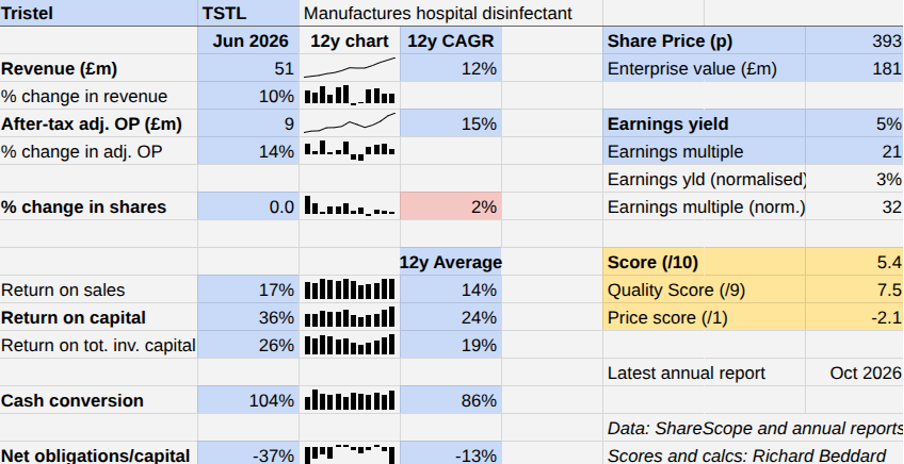
The year to June 2026 was fairly typical. Revenue grew by a slightly sub-par 10%, and profit grew by 14%. Device (endoscopes, probes and so on) revenue grew 12%, earning 88% of revenue and 91% of gross profit.
The company’s range of surface disinfectants was rebranded Tristel Surfaces during the year. It grew strongly from a small base. Surfaces earned 9% of revenue and 7% of gross profit. The remaining 3% of revenue and 2% of profit is attributed to legacy products, which contracted and dragged revenue and profit down. Their contribution is close to negligible now.
- Stockwatch: should you jump on the rebound in this UK share?
- The two UK housebuilder shares tipped to rally in 2027
Tristel manufactures in Newmarket and sells direct through subsidiaries in 19 countries including the UK, its biggest single-country market by far, and the US, which it entered in 2023 and describes as its biggest growth opportunity. Elsewhere, Tristel uses distributors.
Despite warning of increased competitive activity from “lookalike” products of disputed efficacy, Tristel believes it can achieve double-digit revenue growth and EBITDA margin of at least 25% a year out to 2030.
Analysts may be hedging their bets slightly. They forecast growth a fraction shy of 10% out to 2029.
Under new management (again)
The UK is a maturing market because Tristel is the dominant supplier of high-level manual device disinfectant, which has been widely adopted here.
The good news is the UK market is still growing, and Tristel is much less dependent on its home market and the NHS than it was a decade or more ago. In 2026, the home market contributed 35% of revenue. Tristel’s biggest customer contributed 23%.
You would not know it from Tristel’s smooth performance, but the team seeking to extend its run of growth has changed.
Founder Paul Swinney left the business in September 2024, having led it for over 30 years. His successor as chief executive left less than two years later. Current chief executive Chris Lee joined in August. Between June and August, chief financial officer Anna Wasyl stepped in. She joined Tristel in September 2025.
- Trading Strategies: a FTSE 100 defensive play with growth prospects
- The hidden traps in consolidating pensions, ISAs and GIAs
The new managers still regard North America as Tristel’s biggest opportunity. It introduced its chlorine dioxide chemistry there with the launch of Tristel ULT (for ultrasound) in October 2023. It followed up with Tristel OPH, for ophthalmology, in May 2025.
Progress appears slow because Tristel is introducing novel products to large hospital networks used to different disinfection regimes, but the opportunity is large. In 2024, Tristel reckoned the North American ultrasound market was worth $100 million (£76.2 million).
It distributes Tristel OPH through its own sales force and distributors, but Tristel’s share of the ultrasound market is being captured by Parker Laboratories, Tristel’s North American manufacturing and distribution partner for Tristel ULT.
Since Parker pays a royalty to Tristel, Tristel’s revenue is lower than it would be if it were manufacturing and distributing Tristel ULT itself. The quid-pro-quo is that the royalty is all, or almost all, profit, since the cost of sales is borne by Parker.
So far, in terms of revenue, North America has barely dented Tristel’s numbers, which is probably to be expected. In 2026, the company earned £0.3 million in North American royalties. Revenue from the Americas grew from £0.3 million in 2025 to £0.8 million, 2% of Tristel’s total revenue.
Duo vs Trio
Tristel OPH and Tristel ULT are versions of Duo, a product that is increasingly important because of its popularity in faster-growing overseas markets.
Customers like Duo because it is straightforward to use. It is a foam that is applied with a dry wipe. It is also cheaper than Tristel’s premium offering, Trio. Different countries have different regulations and standards, and if a cheaper product will do, hospitals will often plump for it.
Trio is a more complete solution and consequently sells for a higher price. It is a three-stage process, requiring a different pre-wetted wipe to clean, disinfect, and rinse an instrument. Trio’s success in its infection-conscious home market has been a major contribution to growth.
Trio is still growing and Tristel tells me the two products earn similar margins, but, since the mix is changing it will need to sell more Duo than it would Trio to maintain the growth rate. Since the company is “realistic” about the pace of adoption in North America, I wonder if the annual 10% target will become harder to exceed.
- Retiring soon? Here’s how to ride out the AI sell-off
- Sign up to our free newsletter for investment ideas, latest news and award-winning analysis
Other innovations may help. In a development no doubt related to Duo’s popularity, Tristel has launched Visiclean, a cleaning product for use prior to disinfection with Tristel ULT.
The surge in profitability in the Tristel Surfaces segment suggests a focus on critical hospital areas like cancer, neonatal, and emergency wards is paying off. Surfaces achieved higher volumes and higher prices in 2026, and there may be more margin improvements as it scales. Tristel has also added a new product to its line-up: Unifoam, for drains.
A new subscription tier for Tristel’s free 3T training and compliance platform may tie customers closer to its consumables. 3T provides training and guided decontamination through an app and keeps decontamination records. The Pro tier enables hospitals to track equipment and its utilisation.
Scoring Tristel
Tristel makes a unique product that saves lives. Talk of increasing competitive activity is of some concern, but it is not yet obvious in the results.
The company has not been very acquisitive. Mostly, Tristel has restricted itself to buying overseas distributors, once the product is established in a territory. Chris Lee is mooting a more ambitious strategy, perhaps bringing in new products and technologies. I will be sceptical if these do not build on the company’s existing advantages.
| Tristel | TSTL | Manufactures hospital disinfectant | 26/11/2026 | 5.4/10 |
| How capably has Tristel made money? | 2.5 | |||
| Tristel has achieved double-digit revenue and profit growth for over a decade by developing unique hospital disinfectants and introducing them into new geographical markets. It is highly profitable and cash generative. The company’s founder retired in September 2024, and management has been a bit of a merry-go-round since. | ||||
| How big are the risks? | 2.5 | |||
| Unique, prosperous, and financially strong, there are few obvious risks. Tristel reports increased competitor activity but still believes it is the only manufacturer of chlorine-dioxide based products for hospitals. It disputes “lookalike” claims of similar efficacy. A more active M&A programme may become a cause for concern. | ||||
| How fair and coherent is its strategy? | 2.5 | |||
| The company is innovating and protecting products, rolling them out worldwide, and educating customers. Its biggest growth opportunity is North America, which it only recently entered. The sales mix is shifting towards Duo, which is lower priced than Trio, so much depends on the rate of adoption. | ||||
| How low (high) is the share price compared to normalised profit? | -2.1 | |||
| High. A share price of 393p values the enterprise at £181 million, about 32 times normalised profit. | ||||
| NB: Bold text indicates factors that reduce the score. Bold and italicised text doubly so. The maximum score is 3 for each criterion except price, which has a maximum of 1 (explained here) | ||||
| Previous score (June 2026): 6.1 | ||||
Last time I scored Tristel, I penalised it because I thought the plastic in Trio’s pre-wetted wipes might be putting hospitals off the product for environmental reasons. The plastic is required because chlorine dioxide breaks down natural wipes, and Tristel tells me it hears little about plastic from customers. Standards, price, and clinical preferences determine the products hospitals buy.
The main detractor to Tristel’s score is the share price, as it has been for many years.
30 Shares for the future
Here is the ranked list of Decision Engine shares. I review the scores at least once a year, soon after each company has published its annual report. The price scores are calculated using the share price prior to publication.
Generally, I consider shares that score more than 5 out of 10 to be worthy of long-term investment in sizes determined by the ideal holding size (ihs%).
Softcat (LSE:SCT) and YouGov (LSE:YOU) have published annual reports and are due to be re-scored.
| 0 | company | description | score | qual | price | ih% |
| 1 | FW Thorpe | Makes lighting systems for commercial, industrial and public settings | 9.5 | 8.5 | 1.0 | 8.9% |
| 2 | Hollywood Bowl | Operates tenpin bowling centres | 8.3 | 8.0 | 0.3 | 6.7% |
| 3 | James Latham | Distributes imported panel products, timber, and laminates | 8.0 | 7.0 | 1.0 | 6.0% |
| 4 | Renew | Maintains and improves road, rail, water, and energy infrastructure | 7.9 | 7.5 | 0.4 | 5.8% |
| 5 | Porvair | Manufactures filters and laboratory equipment | 7.9 | 8.0 | -0.1 | 5.8% |
| 6 | Cake Box | Cake shop (Cake Box) and sweet shop (Ambala) franchisor | 7.9 | 7.0 | 0.9 | 5.8% |
| 7 | Solid State | Manufactures electronic systems and distributes components | 7.9 | 7.0 | 0.9 | 5.8% |
| 8 | Howden Joinery | Supplies kitchens and joinery to builders and online to DIYers | 7.7 | 7.0 | 0.7 | 5.5% |
| 9 | Anpario | Manufactures natural animal feed additives | 7.7 | 7.0 | 0.7 | 5.4% |
| 10 | Oxford Instruments | Makes imaging and semiconductor manufacturing systems | 7.7 | 7.0 | 0.7 | 5.4% |
| 11 | Quartix | Supplies vehicle tracking systems to small fleets | 7.6 | 7.0 | 0.6 | 5.2% |
| 12 | Volution | Manufacturer of ventilation products | 7.6 | 8.0 | -0.4 | 5.2% |
| 13 | Games Workshop | Designs, makes and distributes Warhammer. Licences IP | 7.4 | 9.0 | -1.6 | 4.8% |
| 14 | Bunzl | Distributes essential everyday items consumed by businesses | 7.1 | 7.0 | 0.1 | 4.2% |
| 15 | Bloomsbury Publishing | Publishes books and educational resources | 7.0 | 7.5 | -0.5 | 4.1% |
| 16 | Churchill China | Manufactures tableware for restaurants etc. | 7.0 | 6.0 | 1.0 | 4.0% |
| 17 | Jet2 | Flies people to holiday locations, often on package tours | 7.0 | 6.0 | 1.0 | 4.0% |
| 18 | Judges Scientific | Acquires and grows businesses that manufacture scientific instruments | 7.0 | 6.0 | 1.0 | 4.0% |
| 19 | Auto Trader | Online marketplace for motor vehicles | 6.9 | 6.0 | 0.9 | 3.9% |
| 20 | YouGov | Surveys public opinion and conducts market research online | 6.9 | 6.0 | 0.9 | 3.7% |
| 21 | Cohort | Manufactures/supplies defence tech, training, consultancy | 6.7 | 7.5 | -0.8 | 3.4% |
| 22 | Macfarlane | Distributes and manufactures protective packaging | 6.5 | 5.5 | 1.0 | 3.0% |
| 23 | Softcat | Sells software and hardware to businesses and public sector | 6.3 | 6.5 | -0.2 | 2.6% |
| 24 | Advanced Medical Solutions | Manufactures surgical adhesives, sutures and dressings | 6.2 | 6.5 | -0.3 | 2.5% |
| 25 | Focusrite | Designs recording equipment, synthesisers and sound systems | 6.0 | 5.0 | 1.0 | 2.5% |
| 26 | Renishaw | Makes manufacturing automation tools and 3D printers | 5.9 | 7.0 | -1.1 | 2.5% |
| 27 | 4Imprint | Customises and distributes promotional goods | 5.8 | 8.0 | -2.2 | 2.5% |
| 28 | Keystone Law | Operates a network of self-employed lawyers | 5.7 | 7.0 | -1.3 | 2.5% |
| 29 | Tristel | Manufactures hospital disinfectant | 5.4 | 7.5 | -2.1 | 2.5% |
| 30 | Goodwin | Casts and machines steel and processes minerals for niche markets | 5.4 | 6.0 | -0.6 | 2.5% |
Click on a share's score to see a breakdown (scores may have changed due to movements in share price). Key: qual is the share’s score out of 9 for the three quality factors (capabilities, risks, and strategy), price is the price score from -3 to +1, and ih% is the suggested ideal holding size as a percentage of the total value of a diversified portfolio.
Richard Beddard is a freelance contributor and not a direct employee of interactive investor.
Richard owns Tristel and many shares in the Decision Engine. He weights his portfolio so it owns bigger holdings in the higher-scoring shares.
For more on the Decision Engine and Share Sleuth, please see Richard’s explainer.
Contact Richard Beddard by email: richard@beddard.net or on Twitter: @RichardBeddard
AIM stocks tend to be volatile high-risk/high-reward investments and are intended for people with an appropriate degree of equity trading knowledge and experience.
These articles are provided for information purposes only. Occasionally, an opinion about whether to buy or sell a specific investment may be provided by third parties. The content is not intended to be a personal recommendation to buy or sell any financial instrument or product, or to adopt any investment strategy as it is not provided based on an assessment of your investing knowledge and experience, your financial situation or your investment objectives. The value of your investments, and the income derived from them, may go down as well as up. You may not get back all the money that you invest. The investments referred to in this article may not be suitable for all investors, and if in doubt, an investor should seek advice from a qualified investment adviser.
Full performance can be found on the company or index summary page on the interactive investor website. Simply click on the company's or index name highlighted in the article.
Disclosure
We use a combination of fundamental and technical analysis in forming our view as to the valuation and prospects of an investment. Where relevant we have set out those particular matters we think are important in the above article, but further detail can be found here.
Please note that our article on this investment should not be considered to be a regular publication.
Details of all recommendations issued by ii during the previous 12-month period can be found here.
ii adheres to a strict code of conduct. Contributors may hold shares or have other interests in companies included in these portfolios, which could create a conflict of interests. Contributors intending to write about any financial instruments in which they have an interest are required to disclose such interest to ii and in the article itself. ii will at all times consider whether such interest impairs the objectivity of the recommendation.
In addition, individuals involved in the production of investment articles are subject to a personal account dealing restriction, which prevents them from placing a transaction in the specified instrument(s) for a period before and for five working days after such publication. This is to avoid personal interests conflicting with the interests of the recipients of those investment articles.